

Learn
The State of Ethical Investing: Analysis of KiwiSaver Portfolios at September 2025
21st July 2026
The best way to verify ethical claims in KiwiSaver funds is by tracking where the money goes. The latest analysis (to end September 2025) shows a drop in overall harmful investments, but slower progress on human rights, weapons, and climate change.
3 minute read.
This article originally featured in Informed Investor and was authored by Mindful Money Founder and Co-CEO Bary Coates.
There has been a revolution in ethical investing internationally. Over the past three decades, the number of investment funds that take ethical issues into account has grown massively. The members of one initiative, the Principles for Responsible Investment, have US$140 trillion under management, a majority of global capital.
Despite the headwinds created by the Trump White House and Republican states, most fund managers are still committed to taking social, environmental and governance (ESG) issues into account. There is strong evidence that this is important for managing risks, meeting client expectations and earning good returns.
A challenge for the fund managers and clients alike has been the different terms used – such as ethical, green, ESG, sustainable and socially responsible. These terms are often used interchangeably (this article uses ‘ethical’ since it is the term most familiar to members of the New Zealand public).
Regulators in the UK, EU, Australia and other countries are in the process of setting rules for the use of these terms, but in the meantime, many consumers are confused and concerned about misleading claims. Surveys show that half of all consumers are concerned about ‘greenwashing.’
The best way to verify ethical claims in KiwiSaver funds is not from the statements of fund managers – most claim to be ethical - but by tracking where the money goes. Mindful Money has found an objective and rigorous way to follow the money, tracing investment flows down to individual KiwiSaver accounts. We identify the issues that most New Zealanders want to avoid in their investments, through annual surveys, and use international research to identify the companies in each category.
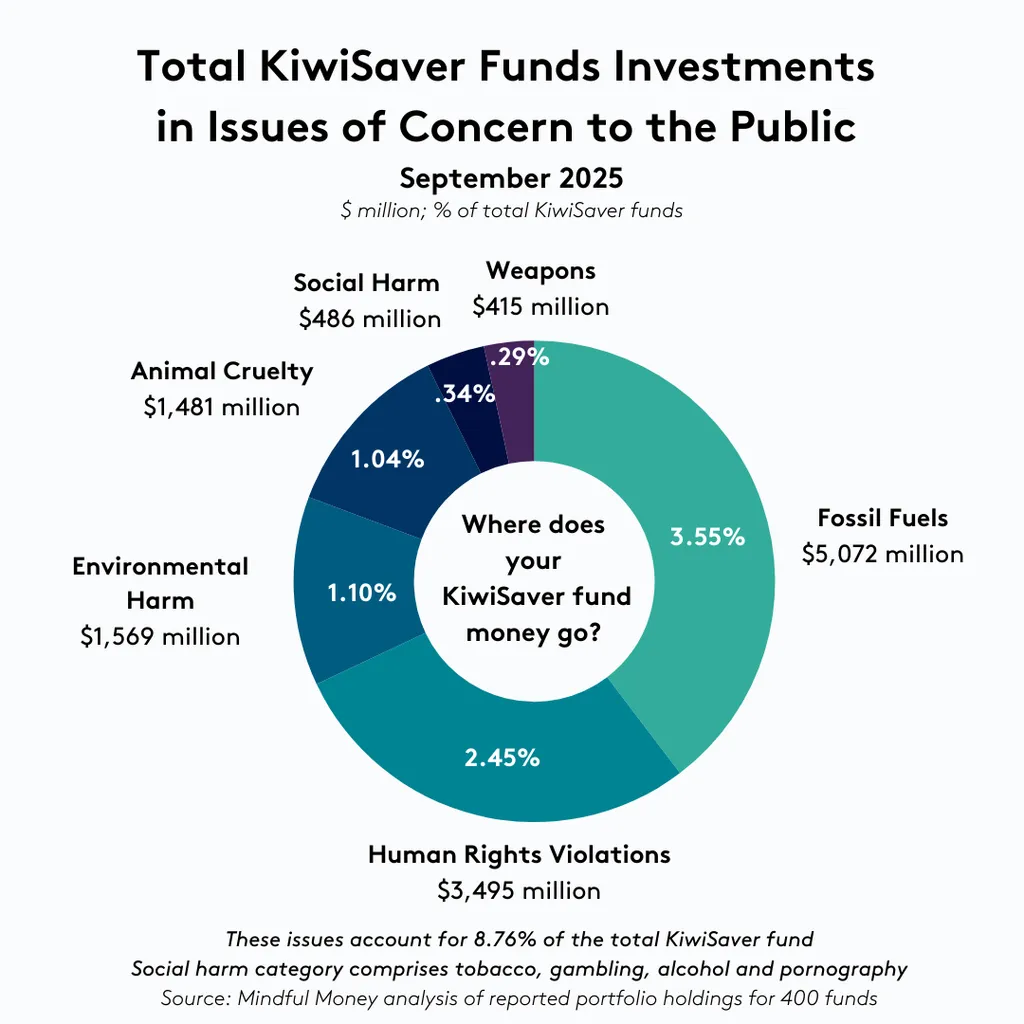
Recent analysis shows that KiwiSaver funds are becoming more ethical overall, but there is still a significant gap between the issues that Kiwis want their KiwiSaver funds to avoid and where it is actually invested. The latest analysis of portfolio holdings to end September 2025 shows that there has been a fall in the overall proportion of funds invested in companies that have harmful impacts on society and the environment, but less progress on issues such as human rights violations, weapons and climate change.
Social Harm
The decline in unethical investment has been the strongest for the traditional unethical issues, such as tobacco, gambling, alcohol and pornography, often avoided on moral grounds. These are the issues that are relatively easy for investment providers to define, since they are tangible products and services. Many of the major KiwiSaver fund have a policy not to invest in these issues.
The rationale for avoiding these products is financial as well as moral. For example, the sales of cigarettes have declined due to education and increased taxes and, despite increases in vapes, the financial returns have been low over the past decade. Similarly, gambling has been affected by regulation and controls over money laundering.
As an example, Sky City’s share price has fallen by three quarters over the last five years and investment by KiwiSaver investors has declined. KiwiSaver investment in social harm fell by 17% in the 6 months to end September 2025.
Animal Cruelty
Around 85% of New Zealanders want to avoid animal cruelty in their investments. In recent years, more KiwiSaver funds have started to pay closer attention to these issues and have started to avoid the worst companies.
The key areas of concern are using animals to test products for non-medical purposes (typically for cosmetics), factory farming, use of animals for entertainment and products such as fur and leather. There was a decline of 17% in investment in animal cruelty in the six months to September 2025.
Environment
Mindful Money’s ground-breaking report ‘Let our Oceans Breathe’, released last October, traced the flow of KiwiSaver funds into companies that contribute to the declining health of our oceans. This occurs through investments in plastics, over-fishing and bottom trawling, deep sea mining, pollution and climate emissions. The report presented KiwiSaver fund providers with the evidence of damage and the names of major companies that are culpable.
KiwiSaver investment in companies contributing to environmental damage increased by 4% in the six month period to end September 2025 (below the increase in overall KiwiSaver investment of 11%), and in ocean harm by 14%.
There are still problematic investments contributing to environmental damage and ocean harm, but this reduced level of investment is an important step in limiting the adverse impacts.
Human Rights violations
There has been less progress on other issues. In each of the past six years, public surveys have shown that the issue of human rights violations is the top priority for New Zealanders to avoid in their investments.
This reflects concern over issues such as abuses of labour rights, the exploitation of children, denial of gender rights, harm to vulnerable people, targeting of civilians in conflicts and corruption/unethical business. These concerns are usually about the harmful practices of companies, rather than their products or services.
The types of concern have changed in recent years. The activities of the large technology companies have come under scrutiny, particularly through harm from social media, surveillance or use in conflict. The companies identified as harming human rights now include major companies such as Meta, Tesla, Thermo-Fisher Scientific and Palantir.
The widening of concerns over human rights has resulted in more companies added to the list and an increase in investments in companies with poor human rights records. KiwiSaver investment in these companies increased by 43% in the past six months to over $3.5 billion.
Human rights in Occupied Palestinian Territories
The has been an increase in KiwiSaver investments in companies that are providing weapons, surveillance or other forms of support to the ongoing conflicts in Gaza and other occupied Palestinian territories. This is despite the ongoing humanitarian crisis and an International Court of Justice decision ruling that the occupation of Palestinian territories is illegal.
A recent UN Human Rights Office report raises concerns over ethnic cleansing by Israeli authorities in both Gaza and the West Bank, amid increased attacks and forcible transfers that appear aimed at a permanent displacement of Palestinians throughout the occupied territories.
Despite widespread public concern, investment in companies that contribute to violations of Palestinian human rights has increased. Major companies, including IBM, Booking, Palantir, Motorola Solutions and Caterpillar, all received increased KiwiSaver investment over the past six months.
The overall increase in investment affecting Palestine human rights was 14% between March and September 2025, to a total of $856 million. These companies are tagged with an OPT symbol on Mindful Money’s website, making it easy for members of the public to identify them in their KiwiSaver portfolios.
Avoiding investment in human rights violations presents a major challenge for KiwiSaver fund providers. Few of the KiwiSaver providers have clear policies that screen out investment in these companies.
Some fund providers claim they can influence these companies through continued investment, but these are major global companies. Small New Zealand fund providers are unable to have a significant influence over their practices.
As with other categories, Mindful Money is calling on KiwiSaver fund providers invested in companies with poor human rights records to sell their holdings.
Weapons
There has been a surge of investment into weapons over the past five years, fuelled by conflicts in Ukraine and Gaza, and responding to planned increases in military spending by most countries.
KiwiSaver providers have been chasing higher returns from a range of military producers - investment in weapons increased by 10% over the past six months and has more than doubled over the past 5 years.
Surveys show that around four fifths of New Zealanders want to avoid investing in all forms of weapons, but many KiwiSaver providers exclude investments only in a narrow range of weapons, such as nuclear weapons or landmines.
While some weapons companies sell to New Zealand’s allies, weapons controls are lax and weapons from the same company can also end up in the hands of terrorists and hostile states, and used to commit human rights violations against civilians.
Climate Change
Surveys show that most New Zealand investors want their KiwiSaver providers to take action on climate change. The most significant change in reducing emissions is to avoid investing in the worst of the coal, oil and gas companies.
These companies, the ‘fossil fuel expanders’, are still increasing their production of fossil fuels and spending millions of dollars to influence the Trump White House and other governments.
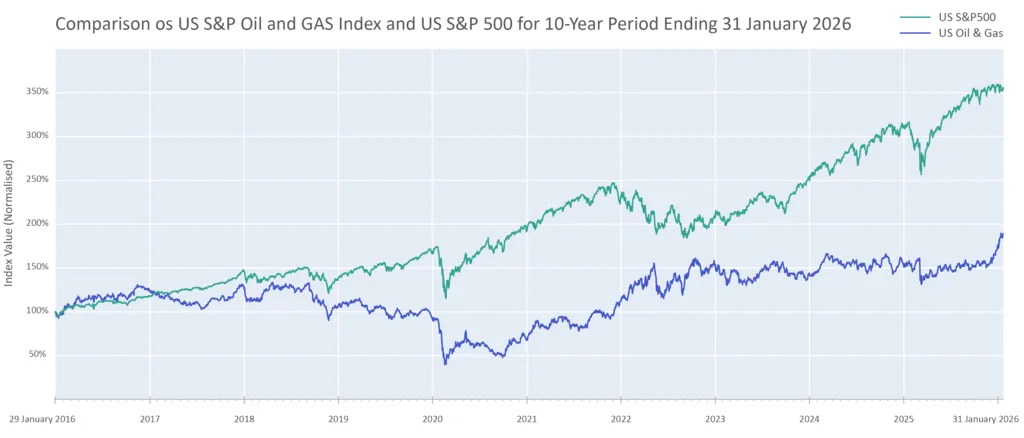
The invasion of Ukraine by Russia in February 2022 resulted in a short-term spike in the prices of oil and gas. Some managers of KiwiSaver funds increased their investments in fossil fuels, chasing short term profits and reversing the previous decline in fossil fuel investment.
However, the increased share prices were short-lived and returns from fossil fuel investments lagged over the 2022-25 period. For most of that period, the returns to fossil fuel companies were significantly lower than the overall market.
Fossil fuel investors also face growing risks of stranded assets – unusable coal, oil and gas reserves and production infrastructure as fossil fuel production peaks and then declines.
Only now have some investment providers started to reduce their fossil fuel exposures.
Investment in the fossil fuel expanders, including Shell, BP and Chevron, fell sharply in the six months to September 2025, by 12% as a proportion of KiwiSaver funds. Even so, over $5 billion of KiwiSaver funds is still invested in fossil fuel companies.
Alongside the decline in fossil fuels, KiwiSaver funds have started investing more in renewable energy. The energy transition is proceeding at pace internationally, creating new opportunities for investors. The economic reality is that renewable energy is the cheapest and most efficient source for most energy uses.
As well as investments in renewable energy companies like Meridian, Mercury and Lodestone Energy, Contact Energy receives over $1.1 billion in KiwiSaver investment and there is growing investment in international transitioning companies such as Nextera and National Grid PLC.
Investment in the transition to renewable energy is accelerating, but not yet quickly enough to avoid damaging climate impacts. The transition away from fossil fuels needs to accelerate in order to protect communities across New Zealand and globally, especially the poorest countries.
Finding Ethical Funds
KiwiSaver investors have choices in their investment. A small group of ‘Mindful Funds’ that meet Mindful Money’s ethical criteria include rapidly growing funds with high ethical standards and strong financial returns, including Pathfinder Asset Management, Generate. Simplicity, Booster SRI Funds, Harbour Asset Management, MAS and Always Ethical.
Members of the public can check the investments in their KiwiSaver funds and find a fund that aligns with their values for FREE here.