

Learn
Stirring up the Truth on Bottom Trawling
15th Jan. 2026
Public momentum to end bottom trawling continues to build as the severity of the detrimental impact on our oceans through this fishing method is brought into sharp focus.
2 minute read
Article authored by Mindful Money Research Analyst Sophie Auckram.
David Attenborough’s film Ocean has highlighted the severity of bottom trawling on our oceans, driven by industrial fishing in our deep seas. This film and the 2025 UN Ocean Conference has brought bottom trawling to the forefront of public attention in recent months. Currently, ultra-marathoner Jono Ridler is swimming unassisted down the east coast of New Zealand’s North Island to raise awareness of these impacts and to call for an end to bottom trawling. Momentum to end the practice, both in New Zealand and globally, is continuing to build.
What is Bottom Trawling?
Bottom trawling is a fishing practice where heavy nets are dragged across the seabed to catch fish. This method is highly destructive to habitats and the seafloor. Nets churn up the same areas of seabed hundreds of times, releasing c370m CO2 annually (Atwood, 2024). In the process, bottom trawling destroys coral, ancient sponge gardens and seagrass meadows which are millions of years old. The catch from bottom trawling nets also includes high amounts of bycatch, unwanted species caught accidentally, which is highly destructive to ocean ecosystems. For example, when catching scampi, every 1kg of scampi caught includes 3.8kg of bycatch (Evans, 2023).
New Zealand vessels are allowed to bottom trawl in the mid-water and on the sea floor in two thirds of its 4 million km2 exclusive economic zone (EEZ). Between 2023 and 2024, 70% of commercial catches used bottom trawling or similar methods passing within 1 metre of the seabed (MPI, 2024). Major companies Sanford, Sealord and Talleys are responsible for a large portion of bottom trawling in New Zealand.
New Zealand has some restrictions on where bottom trawling can take place. Both Sanford and Sealord have been fined for illegally bottom trawling in restricted areas and have also been required to forfeit vessels. However, these penalties seem to have limited effect as deterrents. In July 2025, Greenpeace found Sealord ship the Ocean Dawn illegally bottom trawling - in the same area of the Chatham Rise that it was fined for bottom trawling in 2018 (Greenpeace, 2025).
Bottom Trawling of Seamounts
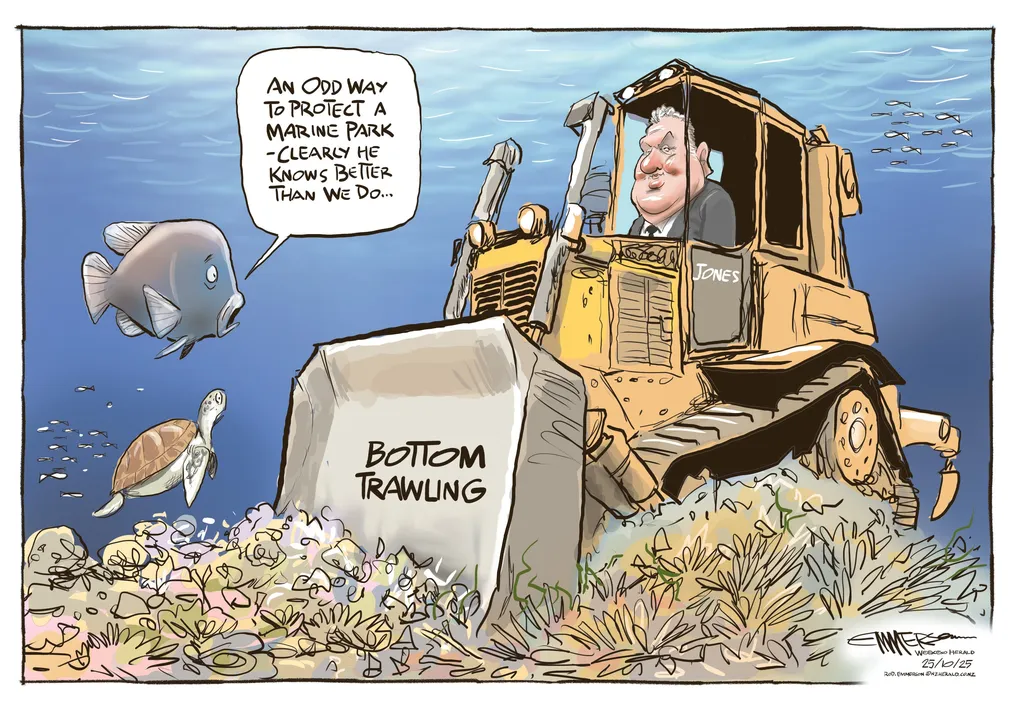
New Zealand also allows bottom trawling to occur on seamounts, against the international consensus for banning this practice. Seamounts are structures which tower over 1km above the ocean floor. They are rife with life from corals and sponges, are important ‘pit stops’ in ocean journeys for many fish, sea turtles, sharks and other species and are key to circulating nutrients in our oceans (Clark, 2025). New Zealand is the only country in the South Pacific which still allows bottom trawling to occur on seamounts.
In 2023 the Labour government proposed to ban bottom trawling, including on seamounts, in 70% of high biodiversity areas of the South Pacific. However, the National government has revoked this commitment (RNZ, 2025).
Bottom Trawling Threatens Orange Roughy
Orange roughy are a deep-sea fish primarily caught within New Zealand waters using bottom trawling around seamounts. They are a unique deep-sea fish which can live up to 200 years and has a low female reproductive rate. Over-fishing in the 1980s resulted in the collapse of eight orange roughy fisheries (Ellen, 2021). The Ministry for Primary Industries is considering closing the East and South Chatham Rise fisheries. The Deep Sea Conservation Coalition claims this species is “past the brink” of collapse. Bottom trawling for orange roughy needs to be stopped urgently to save this species.
Whose Views Dominate in NZ?
There is strong public support for bans on bottom trawling in parts of New Zealand waters. For instance 97.2% of 8,909 submitters to a Forest & Bird campaign called for “a full ban in the Gulf” (Forest & Bird, 2025). Although the Hauraki Gulf Marine Protection Act (2025) increases protected areas, it still permits bottom trawling.
In line with community calls, the Waikato Regional Council has made changes in its upcoming coastal management plan to close the majority of the Hauraki Gulf and the Coromandel Coast to bottom trawling. However, the government has proposed significant changes to the RMA which will limit the ability of councils to make these kinds of decisions (RNZ, 2025). Iwi also have rights over the foreshore and seabed under the Takutai Moana Amendment Bill, however, customary land titles are being undermined by the proposed bill and some previous decisions could be reversed (McGregor, 2025).
The fishing industry continues to lobby against restrictions on bottom trawling. They appear to be prioritising short term profits over the health of marine ecologies necessary to sustain fish population levels.
Call for Greater Protection
Protecting the ocean seafloor is essential for maintaining biodiversity and supporting carbon sequestration. Bottom trawling poses significant environmental risks, yet the level at which it is permitted is unacceptably high. NZ needs to ban bottom trawling to protect our seabeds. Leading fishing companies need to move to sustainable practices.
As an individual, you can take meaningful action by divesting your Kiwisaver holdings from companies that contribute to ocean harm. More information about investment in companies harming our moana is highlighted in our recently released report: “Let Our Oceans Breathe: How Investors Can Support Ocean Health”.
This report also identifies the most harmful deep sea mining, fossil fuel, plastic and waste dumping/pollution companies impacting our oceans.
Ready to Align your Investments with your Ocean Values?
Join the ‘Let our Ocean Breathe’ Campaign! Find out about more simple actions you can take to let our ocean breathe.
Your KiwiSaver and managed fund investments can be channeled away from companies causing ocean harm to investments that protect our oceans. Mindful Money's Fund Finder makes it simple and free to discover funds that match your values. Most providers don't charge switching fees, and research consistently shows ethical funds deliver returns that match or exceed traditional options. Your money can protect our oceans while protecting your financial future.
We welcome you to pass this on! The more informed we are, the better decisions we can make towards protecting our beautiful ocean for the future. Use the power of your networks and share this with your friends, family and ocean loving community.
Image credit: Rod Emmerson. Used with permission.