
Introduction: What is ethical investment?
Ethical investment is when you align your values about real-world impact with your goals for financial returns. Just as many Australians are conscious about their purchasing choices - avoiding factory-farmed products, choosing fair trade, or reducing plastic waste - ethical investing extends these values to your superannuation.
There are different aspects of values and a range of different words are used, often interchangeably. Mindful Investing uses the term 'ethical' as a term to describe sustainable, ESG, socially responsible and socially conscious investment. It is the term most widely recognised by the public.
Your super is invested on your behalf, mainly in companies as well as some loans (bonds) to governments. These investments have real-world consequences, and it's your choice what they are.
Australians want ethical super
Recent research shows the gap between what Australians expect and what they know about their super investments.
What Australians expect from their super:
Research conducted in January 2026 revealed that over four in five (84%) Australians aged 18-65 with superannuation expect their super fund to invest their money in an ethical, responsible or sustainable way.
The same research found that while four in five (79%) Australians are confident their super fund's investment strategy aligns with their values, three-quarters (76%) would be disappointed if their super fund invested in sectors or activities they believe should be avoided.
What Australians want their super to avoid:
The highest priority issues for Australians to avoid with their investments can be grouped into the following categories:
- Animal cruelty (88%)
- Human rights violations (87%)
- Environmental damage (85%)
- Weapons and firearms (80%)
- Fossil fuel mining and power generation (69%)
- Social harm (62-75%)
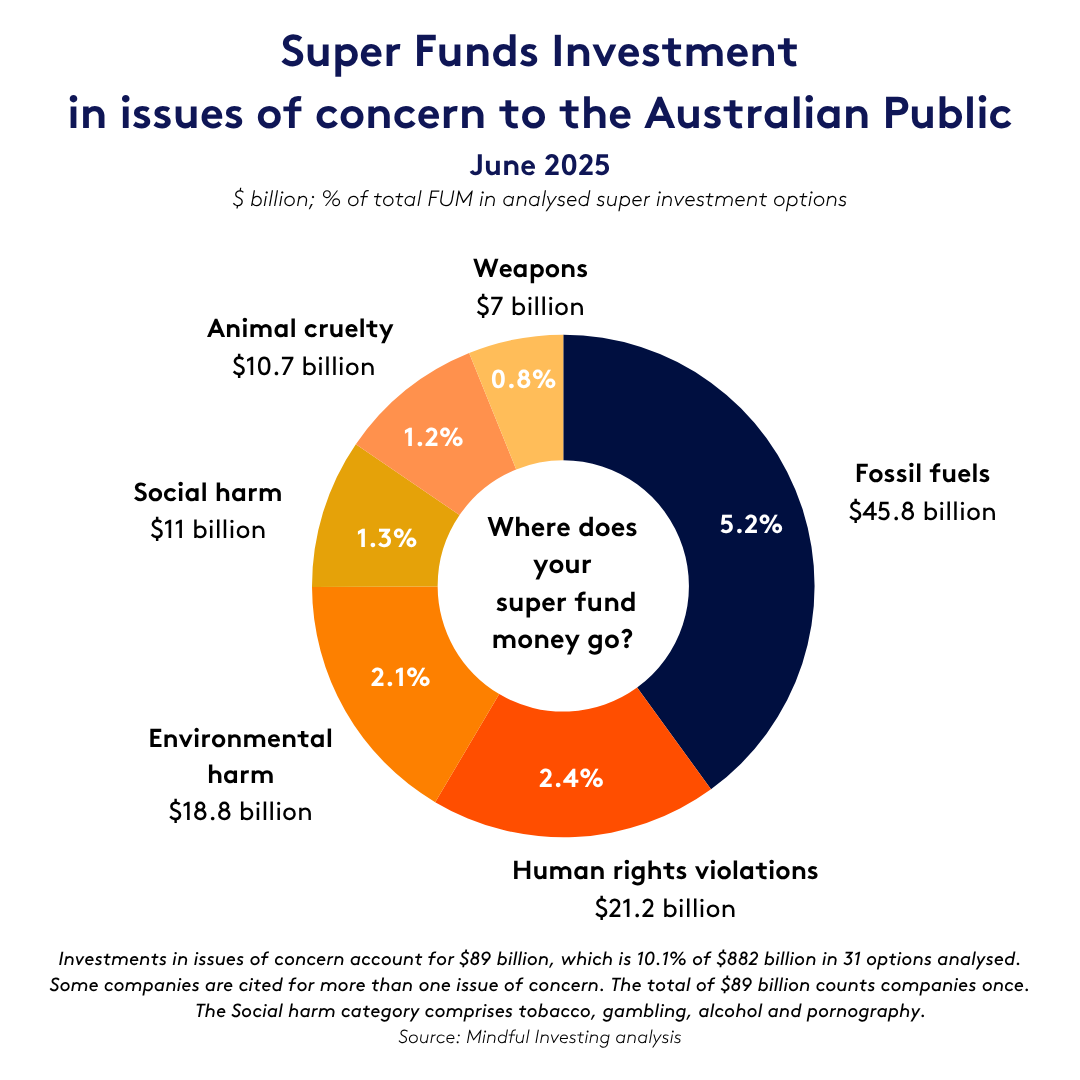
This shows a clear expectation that super funds should invest responsibly - but many Australians don't know where their super is actually invested.
What's actually inside Australian Super Funds
Your super has real impact
While individual purchases matter, investing your super ethically can also have a big impact on people and the planet.
Collectively, Australians hold over $4.5 trillion in superannuation. Even small shifts in how this money is invested can create significant pressure on companies to change their behaviour and redirect capital away from harmful industries toward sustainable alternatives.
Every time you invest money, you're casting a vote for the kind of world you want to live in.
Common questions about ethical investing
"Will ethical investing earn lower returns?"
This is one of the most persistent myths about ethical investing, but research shows the answer is generally not.
Large reviews of research suggest ethical and ESG investing can deliver returns that are broadly comparable to conventional investing, and on average, skew towards higher returns. In some cases, the inclusion of ethical and ESG risk analysis can improve the risk-and-return balance over time.
That doesn't mean every ethical fund will outperform. Returns will always vary, and different funds will generate different results. But if an investor is concerned that investing ethically is likely to result in lower returns, the weight of credible research suggests the answer is generally not.
The evidence:
Evidence includes large datasets of comparative studies such as:
- New York University Stern Centre for Sustainable Business examined more than 1,000 research papers published between 2015 and 2020 on ESG and financial performance. The review found that 59% reported positive or neutral results, while only 14% reported negative outcomes.
- Hamburg University analysed 2,200 comparative studies and found the majority show higher returns for responsible investing.
- Morgan Stanley's Institute for Sustainable Investing examined 11,000 studies and found that responsible investment funds have comparable or better returns than conventional funds.
- The European Securities and Markets Authority compared ESG and non-ESG active equity funds in Europe during the sharp market fall and recovery around the early COVID period. The research found ESG funds performed slightly better than non-ESG peers during the stressed period.
In summary, across a large body of evidence, ethical/ESG approaches are more often linked to outcomes that are similar to, or better than, conventional investing than they are linked to underperformance.
Why do ethical investments perform well?
Companies with strong environmental, social, and governance (ESG) practices tend to be well-managed overall. They tend to:
- Avoid fines and lawsuits for environmental damage or social harm
- Build stronger brand value and customer loyalty
- Have more engaged and productive employees
- Face lower regulatory and reputational risks
- Tend to operate in growing rather than declining industries
By contrast, companies that behave badly often suffer financially—from regulatory penalties, consumer boycotts, stranded assets, or market declines in unsustainable sectors.
Important note: While the evidence is positive overall, there are no guarantees that any specific fund will earn high returns. All investments carry risk, and ethical investing is no exception. Past performance is not a reliable indicator of future performance.
"Isn't all super investing basically the same?"
No. Super funds vary significantly in where they invest your money. Some funds actively avoid harmful industries and invest in companies creating positive impact. Others invest heavily in fossil fuels, weapons manufacturers, or companies with poor environmental or labor practices.
Transparency varies too. Some funds provide detailed disclosure about their holdings and ethical screening processes, while others offer limited information.
"What's the difference between avoiding harm and creating good?"
Ethical investing exists on a spectrum:
- Avoiding harm (negative screening):
- Excluding specific sectors like fossil fuels, weapons, tobacco, or gambling
- Avoiding companies with poor practices or issues such as labour rights, human rights and the environment
- Influencing company practices (stewardship approaches):
- Corporate governance: Using shareholder voting on company resolutions to promote environmental, social, and governance issues
- Active ownership: Using shareholder power to engage companies and influence them towards better practices
- Doing good (positive approaches):
- Impact investing: Intentionally investing to generate measurable positive outcomes alongside financial returns
- Thematic investing: Focusing on solutions like renewable energy, clean technology, or affordable housing
The strongest ethical funds often use several approaches - avoiding significant harm, engaging with companies and actively seeking positive impact.
Diversified ethical investing
Some people worry that excluding certain sectors will limit diversification. However, ethical funds can be well-diversified across:
- Geographic regions (Australian, international developed markets, emerging markets)
- Asset classes (shares, bonds, property, infrastructure)
- Sectors (technology, healthcare, consumer goods, financial services, renewable energy)
- Company sizes (large cap, mid cap, small cap)
Modern ethical funds typically exclude only a small percentage of the overall market - focusing on the most harmful industries while maintaining broad exposure to a far larger number of companies across the global economy. In addition, most of the diversification benefits can be achieved with a limited number of representative companies.
Important information
This website conveys factual information. It presents data relating to environmental, social, ethical and governance attributes of investments and aims to enhance transparency for the benefit of the Australian public. It is not intended to imply any recommendation or opinion about a financial product.
This is educational information, not financial advice. The information on this page helps you understand ethical investing concepts and approaches. It does not constitute personal financial advice for your specific circumstances.
Before making any investment decisions, you should:
- Consider your investment objectives, financial situation, investment goals, and risk tolerance
- Read fund Product Disclosure Statements carefully, which contain important information about fees, returns, and risks
- Understand the risks involved in any investment
- Consider seeking advice from a licensed financial adviser. Financial Advisers with ethical investment expertise can be found on RIAA's list of certified financial advisers and in the Ethical Advisers Co-op directory.
Investment involves risk.
The value of investments can go down as well as up. Past performance is not a reliable indicator of future performance. All super funds carry investment risk, whether they invest ethically or not.
How to learn more:
- Explore our Methodology page to understand how we analyse super funds
- Read our Australian Super Funds Report for detailed analysis
- Use our Fund Checker to see where your super is invested
- For more information on responsible investment, you can go to our New Zealand website and the Responsible Investment Association Australasia (RIAA) website.
The bottom line
Ethical investing is about making your super work for the future you want to see - not just financially, but for the environment and society too.
The evidence shows you don't have to sacrifice returns to invest according to your values. Well-managed ethical funds can deliver competitive financial performance while avoiding harm and supporting positive change.
Most Australians expect their super to be invested ethically. The question is: do your super investments match your values?
Last updated: May 2026. This page provides educational information only and does not constitute financial advice.